Technical Documents
Specifications
Brand
StarTech.comProduct Type
Ethernet Cable
Series
Cat6a - 10Gbit/s
Cable Length
2m
LAN Category
Cat6a
Shield Type
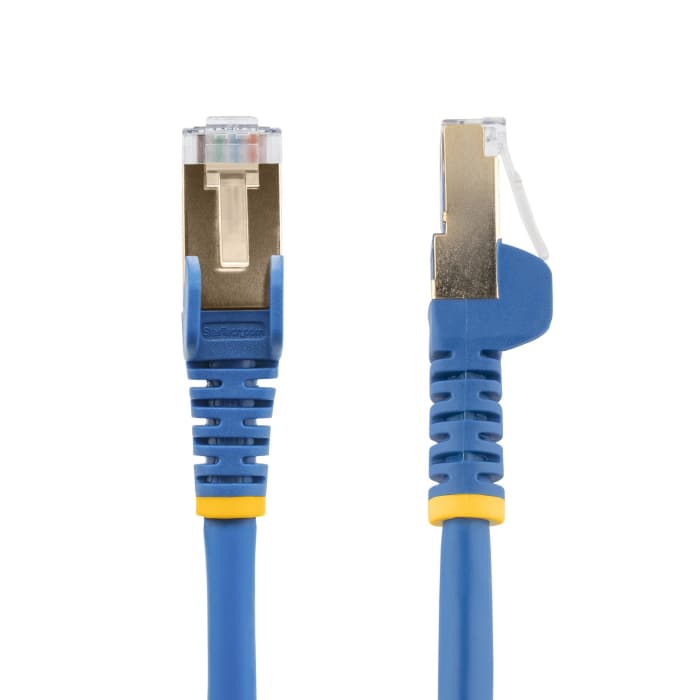
Shielded
Screened/Unscreened
Screened
Conductor Type
Stranded
Jacket Material
Polyvinyl Chloride
Jacket Colour
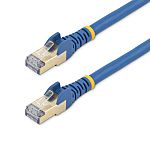
Blue
Fire Behaviour
CMG Rated
Standards/Approvals
RoHS, CE, UL, ETL, REACH
Conductor Material
Copper
Country of Origin
China
Product Details
Use this Ethernet cable from StarTech.com for standard installations such as connecting a wall jack to your laptop docking station or desktop computer. The pure copper stranded conductors ensure a reliable 10-gigabit connection for seamless performance in modern data, CCTV or VoIP phone networks.
What's the difference between a Cat6 and a Cat6a cable?A Cat6a cable can support around double the bandwidth of a Cat6 cable. The Cat6a can also be used for longer cable runs, as it will perform at 10 gigabits over 100m, compared with 37m for the Cat6 cable.
What is a Cat6a cable used for?
Cat6a ethernet cables are used as data cables, directly linking a router or a modem to the device accessing the ethernet. Cat6a is a great choice for large spaces which may not be able to connect to the ethernet within a short distance.
What is the difference between Cat6 and Cat6a
As a rule of thumb, the higher the Cat cabling type, the better the noise reduction and lower attenuation it can handle and as a result, can handle higher bandwidth. For example, Cat6 can handle higher data transfer rates and distances than Cat5.
The main difference between a Cat6a cable and a Cat6 cable would be the amount of bandwidth frequency they can support. Cat 6a can support double the amount of a Cat 6 around 500 MHz. After installation, Cat6a will also perform at 10 gigabits at 100 m, which is over the allocated length for a Cat6 cable (37 m). If choosing between the two, Cat6a is the more logical choice, especially for applications which may require networks at further distances apart.
What about safety?
As a standard, every Cat6a cable is listed as at least LSZH (Low Smoke Zero Halogen). Meaning these cables will emit a very little amount of smoke and no halogen if exposed to a high heat source. Although you should always check the kind of shielded version you need, especially in a high heat environment
Stock information temporarily unavailable.
EGP 1,814.00
EGP 1,814.00 Each (ex VAT)
1
EGP 1,814.00
EGP 1,814.00 Each (ex VAT)
Stock information temporarily unavailable.
1
Technical Documents
Specifications
Brand
StarTech.comProduct Type
Ethernet Cable
Series
Cat6a - 10Gbit/s
Cable Length
2m
LAN Category
Cat6a
Shield Type
Shielded
Screened/Unscreened
Screened
Conductor Type
Stranded
Jacket Material
Polyvinyl Chloride
Jacket Colour
Blue
Fire Behaviour
CMG Rated
Standards/Approvals
RoHS, CE, UL, ETL, REACH
Conductor Material
Copper
Country of Origin
China
Product Details
Use this Ethernet cable from StarTech.com for standard installations such as connecting a wall jack to your laptop docking station or desktop computer. The pure copper stranded conductors ensure a reliable 10-gigabit connection for seamless performance in modern data, CCTV or VoIP phone networks.
What's the difference between a Cat6 and a Cat6a cable?A Cat6a cable can support around double the bandwidth of a Cat6 cable. The Cat6a can also be used for longer cable runs, as it will perform at 10 gigabits over 100m, compared with 37m for the Cat6 cable.
What is a Cat6a cable used for?
Cat6a ethernet cables are used as data cables, directly linking a router or a modem to the device accessing the ethernet. Cat6a is a great choice for large spaces which may not be able to connect to the ethernet within a short distance.
What is the difference between Cat6 and Cat6a
As a rule of thumb, the higher the Cat cabling type, the better the noise reduction and lower attenuation it can handle and as a result, can handle higher bandwidth. For example, Cat6 can handle higher data transfer rates and distances than Cat5.
The main difference between a Cat6a cable and a Cat6 cable would be the amount of bandwidth frequency they can support. Cat 6a can support double the amount of a Cat 6 around 500 MHz. After installation, Cat6a will also perform at 10 gigabits at 100 m, which is over the allocated length for a Cat6 cable (37 m). If choosing between the two, Cat6a is the more logical choice, especially for applications which may require networks at further distances apart.
What about safety?
As a standard, every Cat6a cable is listed as at least LSZH (Low Smoke Zero Halogen). Meaning these cables will emit a very little amount of smoke and no halogen if exposed to a high heat source. Although you should always check the kind of shielded version you need, especially in a high heat environment